Support people affected by cancer in Gisborne, Hawke's Bay, Manawatū, Whanganui, and Taranaki
“What started as a pimple on my nose turned out to be Basal Cell Carcinoma (BCC), a form of skin cancer. I was sent to Hutt Hospital for surgery. This was to be the first of two types of cancer I would face.”
My relationship with the Cancer Society began as a volunteer back when I was forty, offering foot massage services. When people are feeling low, simple things like this make a difference, I call this creating ‘happy feet’. Having now been on the receiving end of services like these it really gives you something positive to look forward to.
My cancer journey started nearly 20 years ago, and it has been a hard road with more than my fair share of hospital visits. My family has a history of cancer on both sides, and I’ve lost multiple sisters to the disease. Some family members have chosen not to have children because of the risk.
I had a few symptoms that prompted a full check up with a doctor which led to a diagnosis for early-stage endometriosis cancer. I had a full hysterectomy to remove it. A fast and straightforward procedure compared to what would follow.
Five years after my initial BCC diagnosis I felt around my facial scar and knew something was wrong. This led to more doctors’ visits and ending up in oncology. There was a period of needing monthly trips from Palmerston North to Hutt Hospital for plastic surgery to have more of my nose removed. They completed a nose reconstruction salvaging as much as they could and I was fine with this thinking they got it all.
“I felt everything drop for me realising the cancer had returned and I was being referred back to plastic surgery.”
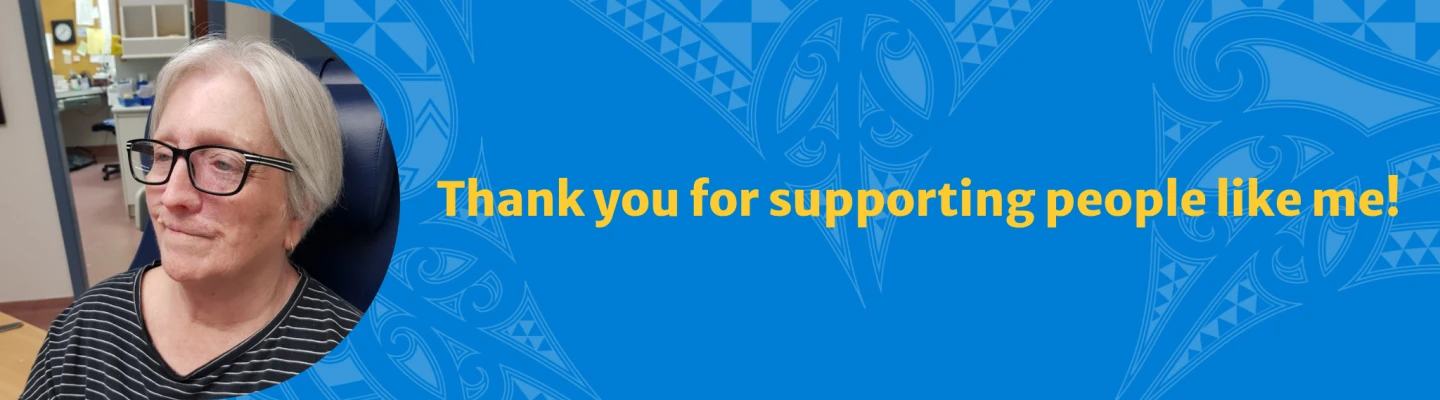
However, twelve years later in 2024 similar symptoms reoccurred including my nose caving in. A month after a biopsy I was back in theatre. The doctor who had seen me over the years said, “I’m not sure what we’re going to do with your nose, but I’ll make sure you don’t die”. The team removed my nose as well as a tumour that was growing near it, something I wasn’t previously aware of. I now have a prosthetic nose with glasses attached I’m still getting used to.
Following radiation, I’ve developed severe allergic reactions that caused acute eczema and extreme face swelling. I was very appreciative for the transport services the Cancer Society provide to get me to clinic appointments when friends and family weren’t available as these complications meant I couldn’t drive.
Cancer is a stigmatised word, many see it as a death sentence, which it often isn’t. People are afraid to talk about it or talk about it without you present as they’re not sure what to say to you directly. The Cancer Society provides an opportunity to ask questions and learn more about cancer and connects you with people who have lived experienced of it.
The supportive care team at the Cancer Society helped me feel stronger in navigating life with cancer. They don’t treat you differently as a cancer patient but as a human.
Some people think meetings and workshops at the Cancer Society are only about cancer but that’s not true. You meet strangers who become friends, people who talk openly and honestly about how they’re feeling and what they’re struggling with. This kind of connection is especially helpful when you’re living on your own.
While it’s unlikely we’ll see a cure for cancer in my lifetime I hope this happens sometime soon, investing in research today creates this possibility for future generations. I would like more people to know about the reality of skin cancer and encourage everyone to take cancer prevention recommendations such as sun safety seriously. I know what it feels like to be a cancer patient, where you can reduce your risk, you absolutely should.
Everyone’s cancer story is different, but the common thread is the need for a strong support network which the Cancer Society provides. Daffodil Day is a chance to support those like me who have found the Cancer Society to be a great comfort during a tough time.
Please support the Cancer Society. What they provide is incredible. 1 in 3 New Zealanders will receive a cancer diagnosis in their lifetime and with your support this journey can be less isolating.
Warm regards,
Fran